 ISSN: 1885-8031
https://dx.doi.org/10.5209/REVE.85561
Hacia la sostenibilidad: el papel del emprendimiento social en la creación de valor socioeconómico en las empresas sociales de energía renovable
Mohammad Jamal Bataineh[1] ,
Carmen Marcuello[2] y Pedro Sánchez-Sellero[3]
,
Carmen Marcuello[2] y Pedro Sánchez-Sellero[3]
Recibido: 7 de mayo de 2022 / Aceptado: 4 de noviembre de 2022 / Publicado: 28 de abril de 2023
Resumen. Este estudio explora el alcance del emprendimiento social y examina cómo el emprendimiento social contribuye al desarrollo sostenible. Utilizando análisis y comparaciones relevantes, identifica a los principales actores en el ecosistema de la empresa social, así como también cómo el ecosistema empresarial se adapta a las empresas sociales. Además, este estudio revela cómo la empresa social se aplica en el dominio de las energías renovables e identifica sus principales ventajas, así como las principales barreras y cómo superar esas barreras. Fundamentalmente, los hallazgos de este estudio tienen implicaciones significativas para académicos y profesionales en el campo social. Destaca el papel del emprendimiento social como un enfoque equilibrado para aumentar la calidad de vida a largo plazo, y sigue técnicas y métodos innovadores para satisfacer las necesidades sociales, inherentemente motivados por factores éticos en la igualdad y la justicia social. Por otro lado, los principales desafíos que podría enfrentar el emprendimiento social incluyen regulaciones gubernamentales, problemas para adoptar tecnología e infraestructura avanzada, amenazas competitivas externas, acceso limitado a fondos o préstamos públicos, falta de conciencia y adquisición de habilidades y conocimiento, y conocimiento inadecuado sobre las técnicas de medición del impacto social. Esta investigación también ilustra cómo adaptar el modelo de Isenberg para el ecosistema emprendedor en las empresas sociales, que muestra que la evolución de las empresas sociales no ocurre en el vacío; más bien, el crecimiento de los ecosistemas de empresas sociales ocurre a través de interacciones y redes con varios actores en diferentes campos, como la política financiera, el derecho y la academia. Finalmente, revisamos las aplicaciones prácticas de las empresas sociales destacando los principales beneficios de las empresas sociales de energías renovables: ahorro de energía, conciencia comunitaria y la creación de externalidades sociales favorables en áreas rurales y en desarrollo.
Palabras clave: Emprendimiento social; Sostenibilidad; Empresas sociales; Ecosistema; Energía renovable.
Claves Econlit: L31; Q01; Q29; P13.
[en] Toward sustainability: the role of social entrepreneurship in creating social-economic value in renewable energy social enterprises
Abstract. This study explores the scope of social entrepreneurship and examines how social entrepreneurship contributes to sustainable development. Using analysis and relevant comparisons, it identifies main actors in the social-enterprise ecosystem, as well as how the entrepreneurial ecosystem adapts to social enterprises. Additionally, this study reveals how social enterprise applies in the renewable energy domain and identifies its main advantages, as well as major barriers and how to overcome those barriers. Fundamentally, this study’s findings have significant implications, for academics and practitioners in the social field. It highlights the role of social entrepreneurship as a balanced approach for long-run increases in quality of life, and it follows innovative techniques and methods to meet social needs, inherently motivated by ethical factors in equality and social fairness. On the other hand, main challenges that could confront social entrepreneurship include government regulations, problems adopting advanced technology and infrastructure, external competitive threats, limited access to public funds or loans, lack of awareness and acquisition of skills and knowledge, and inadequate knowledge about social impact measurement techniques. This research also illustrates how to adapt Isenberg's model for the entrepreneurial ecosystem in the social enterprises, which shows that the evolution of social enterprises does not occur in a vacuum; rather, the growth of social enterprise ecosystems occurs through interactions and networks with various actors in different fields such as financial politics, law, and academia. Finally, we review the practical applications of social enterprises by highlighting the main benefits of RE social enterprises: energy savings, community awareness, and the creation of favorable social externalities in rural and developing areas.
Keywords: Social Entrepreneurship; Sustainability; Social Enterprises; Ecosystem; Renewable energy.
Summary. 1. Introduction. 2. Social Entrepreneurship: definition and characteristics. 3. Social Entrepreneurship and Sustainability. 4. Social Enterprise Ecosystem. 5. Social Enterprises in Renewable Energy Sector. 6. Conclusion. 7. References.
How to cite. Bataineh, M.J., Marcuello, C. & Sánchez-Sellero, P. (2023). Toward sustainability: the role of social entrepreneurship in creating social-economic value in renewable energy social enterprises. REVESCO. Revista de Estudios Cooperativos, 1(143), e85561. https://dx.doi.org/10.5209/reve.85561.
Nowadays, a significant challenge for many national governments, public authorities, policy decision-makers, and economic stakeholders is to fight poverty, help society adapt to new conditions, and promote sustainable economic and social development (OECD, 2010; Horne et al., 2020). Social entrepreneurs play an essential role in stimulating these changes by finding and exploiting new opportunities (Drucker, 1985). They are change-makers (Defourny and Nyssens, 2010; Canestrino et al.,2020), and they start their businesses with the goal of addressing local problems of international concern, such as recycling waste, providing drinking water, supporting small businesses, and training individuals (El Ebrashi, 2013). They also create new processes, creative ways to access markets, and new kinds of services or products. However, developing social entrepreneurship requires refining institutional and legislative frameworks (OECD, 2017). It also requires strategic planning and analysis regarding stakeholders and decision-makers (Satar, 2016). Accordingly, investigating social entrepreneurship and clarifying its trends, obstacles, and characteristics contributes to the literature and practical fields, as well as promotes sustainability and public welfare (El Ebrashi, 2013).
Social entrepreneurship has drawn much concentration recently and has grown in popularity across social areas. (Martin and Osberg, 2007). Much of the increase in attention is due to insufficient results of public projects when it comes to improving the quality of life in certain social sectors (Marqués et al., 2019). Another reason is that many stakeholders — particularly decision-makers, citizens, investors, and entrepreneurs — are more prominent in social enterprises and social entrepreneurship (UNICEF, 2007). Some of this is due to the various structural and legal characteristics of social entrepreneurship (Aisenberg, 2019), including member ownership rather than investor ownership, or even no ownership, as is often the case for nonprofit organizations (Viardot, 2013). Even though the financial markets use profits and other direct benefits to measure the extent of an enterprise's success (Goyal and Sergi, 2015), ethical factors are also instruments to measure the equality and social fairness enterprises generate (De Lange and Dodds, 2017). Further, new techniques and methods to meet social needs (Kawano et al. 2009) also promote innovation, distribute risk, and reduce development and sustainability uncertainties for communities (Stenn, 2017).
Social entrepreneurship typically intends to create societal value rather than pursue personal or shareholder benefit, and the process of such social creation is accomplished by innovation or pattern-breaking change, for instance, the development of novel combinations of goods, services, structures, or methods of production (Phillips et al., 2015). This can be manifested through its dimensions represented by enterprises, social value creation, the entrepreneur, social innovation, and market orientation (Choi and Majumdar 2014). Via these dimensions, social entrepreneurs generate value by sharing social and economic benefits among all participants, including things such as job opportunities and community investment (Meyskens, 2015). In turn, social entrepreneurship focuses on outcomes more than incomes (Defourny and Nyssens, 2010; Kramer, 2005). Growing sustainable organizations is thus crucial for providing social value via long-term capabilities and resources (Kramer, 2005). In addition to fulfilling their social purposes, social enterprises have the potential to be self-sustaining Thus, sustainable development has gained a realized lookout since it supports social, economic, and environmental factors. Although a profit-maximizing company's goal differs from a social business, the managerial philosophy should be the same to further social interest (Bansal et al., 2019). Accordingly, it is essential to evaluate how social entrepreneurship principles and values affect the efficiency and competitiveness of social enterprises (Bretos and Marcuello, 2016).
The energized management and control of natural resources are vital to long-term sustainability in social entrepreneurship through community-led initiatives and increased operational efficiencies (Kamaludin et al., 2021). Social entrepreneurship is inherently sustainable, so the core purpose of social companies is to create sustainability by achieving social and economic goals (Zhang and Swanson, 2014). Therefore, social enterprises must leverage market knowledge to stand influential by maintaining sustainable development while putting community needs first (Kumar and Tiwary, 2020).
Linking social entrepreneurship to sustainable development is shown as a process aims to address sustainable solutions to social, economic, or environmental problems by steadily improving operational efficiencies. This process carries out via stages, it comprises comparing global social or environmental problems with considered solutions; developing an institutional and regulatory framework involving many partners; and implementing the procedures and standards with various economic partners that contribute to economic development, environmental protection, and social equity (Omrane, 2013). Also, it involves cultivating attitudes and trends in social values that stimulate social entrepreneurship. Shaping these attitudes occurs by engaging young talent in educational, and social entrepreneurship activities at universities, schools, and vocational colleges (OECD, 2013). In this process, social enterprises also play an important role in supporting the public services necessary for sustainable development and fundamental social-economic needs, including economic and social welfare, and minimizing environmental harms. These public services include health and education, social services, energy, water supply, transportation, and waste management (European Commission, 2013). There is no question that economists, ecologists, and decision makers around the world are trying to address pollution and increased global warming, as well as shortages of energy sources and sustainable development. Governments and policymakers are consequently promoting renewable energy technologies (Yaqoot et al., 2016).
According to intergeneration theory, attaining sustainability and protecting the environment is an ethical commitment towards future generations (Khan et al.,2020), Since its origin, one of the defining characteristics of this theory has been the realization that relationships are reciprocal—that each member in the relationship is affected by the interaction with another (VanderVen, 2004). For that, the transition to a sustainable energy system is not only a technological and economical challenge, but it also requires behavioral changes (Coenen et al., 2017), which the success of RE social enterprises, depends on collective and citizen-based dynamics (Rijpens et al.,2013), to improve quality of life by promoting economic, social, political, and cultural assets; they also influence public policies (Znagui and Rahmouni, 2019). Policymakers globally are working to transform energy systems, and many strategies have been pursued to increase the diffusion of renewable energies (Yildiz et al., 2015). Given the rapid advancements in RE technology, rising levels of state support, and the dynamic situation in energy provision, it is now an ideal moment to explore the role of social enterprises in the production and utilization of RE (Van der Horst, 2008). Therefore, using RE sources as a substitution for old sources (such as Fossil fuel) is fundamental in reaching targeted sustainability (Khan et al.,2020) by pursuing the best sources of energy, materials, and production in order to minimize the business effects on ecosystems while maximizing benefits to communities (Stenn, 2017). In addition to developing RE policies, this transformation will necessitate the long-term commitment of all stakeholders, including governments, citizens, financiers, private corporations, and international organizations (Kahia et al., 2017).
Embracing entrepreneurial ecosystems and social entrepreneurship are stimulating activities at the convergence of economics and society that are crucial to economic outgrowth and wealth creation in the long term (Roundy, 2017). In this way, entrepreneurial ecosystems tie to entrepreneurship-specific resources conveyed by multiple overlapping sets of attributes and institutions that support the development and growth of innovative startups. An ecosystem typically has sustained features through its relationships with various factors, such as social, political, economic, and cultural elements (Spigel, 2015). Confirming ecosystem approach, a system is not fixed but rather evolutionary, developing and adapting in response to new demands and conditions (Hechavarria and Ingram, 2014). This implies that entrepreneurial ecosystems that encourage and actively utilize social entrepreneurship have more possibility to grasb stakeholders' attention and address community problems (Roundy, 2017). following that, This study follows Isenberg's (2010) entrepreneurial ecosystem’s model but in the context of social enterprises that look up sustainability through building compatible cooperative networks with several stakeholders, such as customers, suppliers, and partners. Cooperatives are not the only business model applicable for financial citizen engagement in energy industry. However, they are a more applicable organizational structures for active participation in local energy policy and supply renewable energy's institutional framework for citizens to participate in the political, social, and financial aspects (Yildiz et al., 2015).
Therefore, the research questions follow: Does social entrepreneurship influence sustainability? How can we adopt an entrepreneurial ecosystem attractive in social enterprises? What are the prospects of social initiatives in renewable energy and their institutional opportunities and restrictions?
This guides these questions; this article studies the influence of these contextual and structural factors. Social enterprises vary among countries, so we explore how the institutional configuration of the energy sector facilitates or constrains social enterprises for renewable energy. Because we are interested in the prospects of social enterprises RE, it is important to understand how and to what extent in current policy arrangements the governments, markets, and civil society complement social enterprises RE initiatives, and to what extent they compete with, adopt, or take over those initiatives. By identifying social enterprises and their institutional opportunities and constraints, we identify the institutional conditions under which social enterprises can partner with governments in a search to shift from fossil fuels to renewable energy. Besides, recognizes the attributes that can comprise the dynamics of the Social Enterprise ecosystem and how they interact with the active actors. That establishes a basis for future research approaches that may examine and compare entrepreneurial ecosystems to highlight the many ways they operate in the context of social enterprises.
The methodology is based on analysis, synthesis, interpretation, and relevant comparisons. We identify some key areas for further investigation, propose assumptions based on prior studies that provide detailed views of how social entrepreneurship affects sustainability, and explore the main factors that influence this relationship. Further, we propose a model for a social enterprise ecosystem by adapting Isenberg (2010). We also discuss how practitioners can overcome the barriers that social enterprises face in the field of renewable energy.
The article is organized as follows: the next section is devoted to describing the theoretical framework of social entrepreneurship, as well as definitions, characteristics of social entrepreneurship. The section three is focused on the relationship between social entrepreneurship and sustainable development, and the main obstacles social enterprises encounter. The fourth section clarifies the main actors in social enterprise by adapting Isenberg's model of the entrepreneurial ecosystem. The fifth section explores the phenomena of social enterprises in renewable energy sources, their advantages, the possible barriers, and how to manage these constrains. Last, the study concludes with the final remarks drawn from our findings.
2. Social Entrepreneurship: definition and characteristics
There are two main approaches to social entrepreneurship definition: the Anglo-American approach and European approach. The Anglo-American manner focuses on the roles of private sectors and shared confidence among market pillars to solve social matters in communities. In contrast, the European approach puts stress through stringent regulations and direct intervention of government authorities in social organizations to achieve goals that have political advantages for social innovation (Defourny and Nyssens, 2012). Most important, the European method concentrates on collective benefits more than individual benefits. Exploring social entrepreneurship and clarifying the unique behaviors, characteristics, and typologies of social enterprises advances the research on sustainable public wealth rather than just focusing on private wealth and business performance (El Ebrashi, 2013).
Even though traditional entrepreneurship and social entrepreneurship are different, both center on finding new opportunities, innovation, and sharing risk and uncertainty. (Palacios-Marqués et al., 2019). However, social entrepreneurship concentrates more on social matters (Martin and Osberg, 2007). Even though there are several definitions of social entrepreneurship, it can define as an entrepreneurial activity with a social objective (Austin et al., 2006) to creatively address social problems (Peredo, 2008; OECD, 2010).
Social entrepreneurship occurs in various legal forms and markets, operates according to its own rules and logic, and relies on creating and delivering value. It is also a rational path to solving social problems while increasing profitability (Santos, 2012), and thereby stimulates the creation and strengthening of social ties within a community (Dufays and Huybrechts, 2014). Remarkably, social enterprises address two sides of the business-society relationship: considerable advancement of sustainable development, and mitigating or avoiding negative impacts (OECD, 2011). Therefore, social entrepreneurial activities are an innovative way of exploitation and utilization the resources that seek to catalyze social change by meeting basic human needs on a sustainable basis (Huybrechts and Nicholls, 2012). Difficult for social enterprises to convey social transformation entirely alone, they need government assistance by relying on its policies to help them develop (Kamaludin et al., 2021). That being so, governments should reinforce their environmental regulations even further which will push firms to embrace green energy sources and sustainable practices (Khan et al.,2020).
Market orientation typically adopts social entrepreneurship in various ways, most prominently in the for-profit social enterprise form, which works in commercial marketplaces and earns profits to reinvest in their social goal (Huybrechts and Nicholls, 2012). In this way, many social enterprises aim to promote justice, including balance, fairness, equality, righteousness, empowerment, and participation in decision-making (Stenn, 2017). For example, Social Enterprise in the United Kingdom asserts that the goal of social enterprise is sustainable development (British Council and SEUK, 2015). Thus, Social enterprises primarily measure their performance in two ways: economic advancement and social impact (Satar, 2016), in order to reach out equilibrium among organizational objectives, utilization the resources, and stakeholders’ satisfaction (Nguyen et al., 2015).
Regarding the main characteristics of social entrepreneurship, any firm that identifies possible opportunities and weaknesses and understands business trends builds competitive advantages. Similarly, the ability to explore opportunities, innovate, and make social commitments are important characteristics of social entrepreneurship (Palacios-Marqués et al., 2019). However, social entrepreneurship has a main difference from traditional entrepreneurship: it plays a more purposeful role in solving or reducing social problems (Zhang and Swanson, 2014).
In the same vein, Nicholls (2006) contends that the main characteristics of social entrepreneurship are social goals, innovation, and market orientation: 1) Social goals often fall into seven categories: education, health and welfare services, economic growth, disaster relief and support from war, natural disasters, social justice and political participation, and environmental issues (Huybrechts and Nicholls, 2012); 2) Innovation indicates the ability to generate new ideas that address social problems and that are appropriate and effective both socially and economically (Zhang and Swanson, 2014); and 3) Market-oriented companies provide products and services in a way that generates profits to reinvest in their social mission, (European Commission, 2011; Huybrechts and Nicholls, 2012), this reflects an ability to understand consumers and distribute relevant products (Teece et al., 1997; Palacios-Marqués et al., 2019). In this way, European economic and social committees (2017) discuss the shared characteristics of entrepreneurial social enterprises, as well as their compromises between profits and social purpose, surplus profits, legal patterns, innovation, decision-making, and democratic governance.
Similarly, one prominent characteristic of social entrepreneurs is that they are less dependent on financial markets. Hence, their businesses are often less affected by financial crises (Birchall, 2013). Social entrepreneurship does still require self-sufficiency, but developing that self-sufficiency differs from traditional methods in that it focuses on socioeconomic outcomes via value-added consumer products (Goyal and Sergi, 2015). Another prominent characteristic of social entrepreneurs is that they generally reinvest their profits in a social mission; they also often sell products and services at low prices in order to be accessible to lower-income consumers (Defourny et al., 2019), and thereby attaining the balance between social impact and their business success in the market (Puumalainen et al., 2015).
3. Social Entrepreneurship and Sustainability
Social entrepreneurship is a continuous process of building long-run sustainability by responding to external factors and utilizing available resources. Thus, it has been emerged as one of the best effective instruments for fostering sustainable development, which includes social, economic, and environmental aspects (Bansal et al., 2019). Social entrepreneurs therefore seek to integrate social purpose with productivity and business efficiency in order to gain competitive advantages (Zhang and Swanson, 2014). Accordingly, social enterprises often must draw up sustainable plans and coordinated policy frameworks to improve and support policies and innovative programs (OECD/EU, 2019). Disseminating entrepreneurship culture and enhancing entrepreneurial spirit also help social entrepreneurs identify resources, existing opportunities, and problems, as well as generate new solutions to enhance sustainable development (Korsgaard et al., 2015).
The concentration on value-creation, however, facilitates social entrepreneurs' work of addressing social problems and sustainable solutions rather than being only concerned about their organizations. Social entrepreneurs embrace empowerment and participation in decision-making for people inside and outside the organizations (Santos, 2012); this attribute is important to engage society in developing social enterprises. Commonly, such these enterprises have a shared mission to reduce the inequalities of power in consequence of social exclusion. (Puumalainen et al., 2015). While embracing new techniques to work for inclusive prosperity in rural communities, social entrepreneurs confront numerous hurdles, including stiff resistance frequently (Bansal et al., 2019). Aside from raising awareness of social entrepreneurship and introducing it to individuals considering options for addressing a social problem, support organization programs can also provide valuable services and instruction to social entrepreneurs who might lack skills (Roundy, 2017). Consolidating new diverse skills are prerequisites for fostering social inclusion and sustainability. These skills primarily include those required to enter the workforce, as well as entrepreneurship and management skills such as strategic planning, marketing, customer service, growth, and research and development (Spear et al., 2012).
Social enterprises put forward a new nonprofit model of creating sustainable value for communities by stimulating or meeting social needs (Nicholls, 2006; Canestrino et al, 2020). Social entrepreneurs yield substantially social value by delivering social benefits, besides economic value through creating jobs and income for their venture while carrying out their vision and goals (Bansal et al., 2019). Thus, understanding the values and beliefs that affect social context is considered the primary move to adopting social entrepreneurial' practices (Canestrino et al,2020). Meanwhile, a multiplicity of funding sources helps social entrepreneurs share risk and reduce uncertainty by increasing public and private resources (Omrane, 2013). Though a lack of resources is considered the most significant barrier to responsible business practices, resource-constrained entrepreneurs are looking to survive through familiarize themselves with innovative business models (Bansal et al., 2019). Kramer (2005) defines sustainability as maintaining social impact and a related business model over a long period, with the possibility of desired growth and development that meets the needs of current generations without threatening the ability of future generations to meet their own needs (Omrane, 2013).
Notably, promoting social entrepreneurship as public policy also helps meet recruitment requirements. Further, overcoming economic and social challenges in a sustainable way minimizes reliance on traditional methods of providing jobs (OECD, 2013). Regardless of whether a firm's profit-maximizing goal differs from that of a social enterprise, the managerial approach should be the same in both cases (Bansal et al., 2019). Douglas and Prentice (2019) also point to the role of social entrepreneurship in increasing innovation and employment, adopting new technology, enhancing production, and improving social equality, all of which enhance national wealth and sustainable economic growth. Bansal et al. (2019) argue that social entrepreneurship can help create the prerequisites for sustainable development. It focuses on six dimensions: rural and community development and urbanization; innovation and technology; social, economic, and environmental concerns of social entrepreneurs; women entrepreneurs; corporate social responsibility; and methods of financing and crowdfunding.
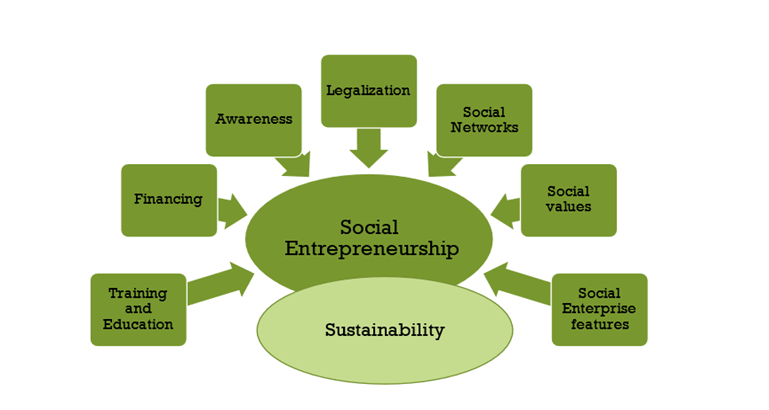
Notwithstanding, scopes of social entrepreneurship may face various barriers to innovation and growth, but they are also opportunities. Overall, human behavior, economic issues, and attitudes and beliefs toward the importance of social entrepreneurship in societies are considered fundamental matters in determining the relationship between social entrepreneurship and sustainability (Santos, 2012). In detail, Fig. A.1 explores the main factors that control this relationship.
Figure. A.1: Main factors in the relationship between social entrepreneurship and sustainability
Source: Developed by Authors
As Fig. A.1 shows, there are several barriers and drivers to consider: 1) Lack of professional training and education: Social enterprises have trouble competing with traditional enterprises without developing certain capabilities (European Commission, 2013). 2) Low access to financing: Access to financing is critical for developing social enterprises and achieving sustainability (European Commission, 2013). Strong relationships with diverse financial sources and minimal reliance on public funding are key (OECD/EU, 2017). 3) Lack of awareness: A lack of awareness, especially by the media, obscures the social value that social entrepreneurship generates (European Commission, 2013), which is due to the fact that social enterprises have various structural and legal forms (Lubberink, 2019). 4) Lack of uniform regulation and standards across countries: Not all social enterprises are subject to the same regulations, which creates obstacles for competition (European Commission, 2013). 5) Social networks: It involves relationships between actors, be it individuals or organizations. creating social networks is considered a feature of social entrepreneurship in comparison to commercial entrepreneurship (Dufays and Huybrechts, 2014). 6) Limited knowledge about how to measure social impact: Social impact mainly is measured to access resource and satisfy resource providers. However, a lot of social entrepreneurs lack adequate knowledge about how to measure social impact because there is no consistent measurement tool (Nguyen et al., 2015). Additionally, McKinsey points out that 49% of social enterprises do not measure their impact (European Commission, 2013). 7) Difficulty among stakeholders in identifying specific features and impacts of organizations. This is due to the use of varied terms to identify social enterprises and other organizations (OECD/EU, 2019). Typically, they are different from other organization types in their aim to benefit the community, their operation by groups of citizens, their participation in decision-making, and their limited distribution of profits (Defourny and Nyssens, 2010).
Despite the abovementioned challenges, the recent advancements indicate notable features for social enterprises (McMullen, 2018). They are pivotal partners in the economy and society by providing public services, as well as encouraging fairness, equality, and social values (Defourny and Nyssens, 2010). However, Social and economic problems often reflect an imbalance of power among economic actors.
Therefore, a social enterprise is successful if it changes the socioeconomic system through actors and technologies (Martin and Osberg, 2015). Nonetheless, the growth of social enterprises is contingent on various factors. This often begins with tackling conflicts related to government institutions and regulatory environments that do not value partnerships with social entrepreneurs; it also involves keeping in touch with bilateral and multilateral organizations (Hartigan, 2004), Furthermore, government regulations can support educators and entrepreneurs besides governing entrepreneurial education and research activities, thus contributing to sustainable development (Bansal et al., 2019).
4. Social Enterprise Ecosystem
As noted above, social entrepreneurship may face various barriers to innovation and growth. However, these factors are strongly related to the social enterprise ecosystem at the macro level. The ecosystem approach highlights both the changes in the entrepreneurial system and the policies that address the complex challenges entrepreneurs face (Hechavarria and Ingram, 2014). In the ecosystem of social enterprise, the presence of multiple stakeholders puts entrepreneurship in a social context (Lumpkin et al., 2011) encompassing social networks, investment capital, universities, and economic policies supporting innovation-based ventures (Spigel, 2015), customers (whose role is to shift the power balance), and the government (whose role is to alter the policies and economics) (Martin and Osberg, 2015). Adopting an ecosystem attractive to social entrepreneurs in turn increases entrepreneurial diversity and captures the attention of the media and other stakeholders (Roundy, 2017), including customers, suppliers, producers, business associations, and standardization bodies (Surie, 2017). Consequently, a successful entrepreneurial system requires some pre-existing economic advantages including cultural, social, and material privileges (Spigel, 2015).
A report from the European Commission (2020) indicates that the main actors in the social enterprise ecosystem include government institutions, customers, social partners, observatory organizations, incubators, public funds and donations, educational and training establishments, and business support providers. Meanwhile, Znagui and Rahmouni (2019) propose that the ecosystem model supports the creation of social innovation that overcomes institutional, financial, and technical obstacles. This model includes the government sector, banks and public finds, social networks, media, and cultural entities, as well as education and research institutions.
Introducing a dynamic social enterprise ecosystem at the macro level requires more government attention to social perspectives, new policies and regulations to generate demand that encourages the entry of new public and private organizations, new networks and interactions, and marketing capabilities (Surie, 2017). Isenberg (2011) proposes a model for an entrepreneurial ecosystem that has six parts: policy, market, support, culture, human capital, and finance. They encompass the following factors: leadership, government, culture, success stories, human capital, financial capital, entrepreneurship organizations, education, infrastructure, economic clusters, networks, support services, and early customers. Based on prior studies and their outcomes, this study adopts the model in Isenberg (2010) on social enterprises. Table A.1 shows the components.
Table. A.1. Actors and Dynamics of Social Enterprise Ecosystem
|
Actor |
Actor Description |
Interaction with Actor |
|
|
Social leaders |
Social entrepreneurs (individual and collective entrepreneurs) and other nonprofit organizations. |
Acts as strong, public advocates of social entrepreneurs. |
|
|
Governments |
|
Provides a supportive regulatory environment, instruments, infrastructures, and measures for social enterprises. |
|
|
Culture at large |
Tolerates honest mistakes, honorable failure, risk-taking, and contrarian thinking. Cooperative culture, mutual support experiences, and community experiences. |
Promotes social values, participation in decision-making, and empowerment of civil society. |
|
|
Visible success stories |
Members of the public see that they too can become social entrepreneurs. |
Inspires youth and other members of the public to become social entrepreneurs. |
|
|
Knowledgeable people |
Professional board members and advisers in social enterprises. |
Builds structures, systems, hiring, and controls. |
|
|
Capital sources |
Social networks and partnerships. |
Attracts funders to support the social enterprises. |
|
|
Nonprofit associations |
Organizations that can act as observatory bodies. |
Monitors development and assesses the needs and opportunities of social enterprises. |
|
|
Educational institutions |
Universities and research centers. |
Disseminates social values. |
|
|
Public infrastructure |
Supply chain infrastructure, container shipping, road, and other public services. |
Reinvests profits to build more facilities and infrastructure rather than distributes to founders and stakeholders. |
|
|
Geography |
Appropriate locations to set up cooperative ventures for renewable energy. |
Is close to universities, standards agencies, vocational training, suppliers, consulting firms, and professional associations. |
|
|
Formal or informal groups |
Social entrepreneurs in various networks and countries with broad experience. |
Promotes policies and cooperation with external experts in adopting new developments in social enterprises. |
|
|
Venture-oriented professionals |
Experts in different specializations (such as technical consultants) working in the social field. |
Exchanges information, knowledge, and required skills. |
|
|
Local potential customers |
|
Empowers customers and engages them in decision-making. |
Source: Developed by Authors based on Isenberg's model (2010)
Social entrepreneurs are mission-driven leaders who employ a set of entrepreneurial attributes to deliver social value. It comprises, for instance, culture, identity, personality, cognition, behaving entrepreneurially, and individual traits (Kamaludin et al., 2021). To establish and sustain their enterprises, they seek funding from nonprofit-oriented investors such as private philanthropic foundations and other sources of grant money (Roundy, 2017). They also can contribute to shaping entrepreneurial ecosystems that have surfaced as pivotal engines for community and economic development (Roundy, 2017). For example, Communitech, non-profit entrepreneurship assist organization, has had remarkable success in spreading the mindset of technological entrepreneurship (Spigel, 2015).
The exploration of ecosystems should crystallize not only on the outcome measures of entrepreneurship but even on the inputs, such as the localized cultural, social, and material attributes that support entrepreneurial activity, as well as how these attributes interact and reproduce the overall ecosystem (Spigel, 2015). Ecosystem environment factors include networks of well-knowledge actors, mentors or role models, and competitors who have a social influence on a learning area (Hechavarria and Ingram, 2014). On another side, public policies are a critical part of the entrepreneurial ecosystem to handle specific problems (Huybrechts and Nicholls, 2012). In particular, government policies and universities can assist in fostering these cultures and networks by reducing institutional impediments to entrepreneurship, training skilled workers and entrepreneurs, and sponsoring support programs such as networking events and incubation facilities (Feldman and Francis, 2004; Spigel, 2015). Governments even can supply infrastructure and other commodities that markets lack (Feldman and Francis, 2004).
Therefore, success and higher brand value thus come not only from the relationship between firms and customers, but also from network relationships and social interactions within an ecosystem that considers all stakeholders (Ketprapakorn and Kantabutra, 2019). Thus, if a social enterprise seeks sustainability, it must construct consistent cooperative networks with several stakeholders, such as customers, suppliers, and partners. These networks help social enterprises develop their marketing capabilities and expand their services. They also support entities and non-governmental organizations (NGOs) that aim to become social enterprises by facilitating suitable environments, workshops, and training for universities that want to enhance teaching, incubation, and community development (Pratono and Sutanti, 2016).
5. Social Enterprises in Renewable Energy Sector
Renewable energy (RE) is a convenient option and substitute for traditional methods of energy production (Chen et al., 2007). Thousands of social enterprises, often cooperatives but also foundations or associations, are active across Europe and promote renewable energy (Rijpens et al., 2013). Social enterprises around RE are often local, decentralized, NGOs that aim to develop the production and consumption of RE (Heras-Saizarbitoria et al., 2018). Thus, they require to create strong RE entrepreneurial ecosystems to enable the diffusion of new technologies and facilitate the entry of different kinds of enterprises (Surie, 2017).
RE investment is risky and often has a long payback period (Guardiola et al., 2009). However, renewables open a window of opportunity in ‘‘post-fossil’’ development for an extensive and still-growing industrial metabolism (Fischer-Kowalski and Haberl, 2007). RE dominantly contributes to boosting international trade, and it also appears as an indicator for the countries to measure financial health (Khan et al., 2020).
Developing social enterprise projects not only represents an aspect of social entrepreneurship. However, it is taking into consideration to maximizes the profits without neglecting the core mission (Pomerantz, 2003). In another way, it contributes to adapting the ecosystem by initiating influencing stakeholders’ preferences, institutional and organizational changes (McMullen, 2018).
Accordingly, to boost RE adoption, social enterprises have to influence behavior and build strong relationships with various partners (Viardot, 2013). Nonetheless, the shift from fossil fuels to renewable energy is fundamental to achieving sustainable socio-economic systems, in addition to fighting pollution, climate change, and fossil fuel depletion (Capellán-Pérez et al., 2018). In the macro environment, there are various societal and network cooperators in communities (Walker and Cass, 2007). Most reject the use of centralized fossil fuels and nuclear energy, and they embrace local egalitarian values (Dóci and Vasileiadou, 2015). Hence, adopting a new RE entrepreneurial ecosystem requires building the infrastructure for social entrepreneurship at the macro level and spurring the entry of social enterprises at the micro-level (Surie, 2017).
Renewal Energy Social Enterprises models
In this context, Rijpens et al. (2013) explore business models for RE social enterprises in six groups. The first group includes local citizens and works mainly through volunteers rather than permanent employees. The funds are limited and essentially come from members. This group usually operates in small towns or villages; for instance, they may renovate a watermill in a village in order to produce electricity.
The second group is bigger; its members have shared interests and diversified funding sources. They work with volunteers as well as employees to develop photovoltaic cells and wind projects at the country level. For example, Solar Surge, launched by a nonprofit organization called Ecooo (http://ecooo.org), creates campaigns to purchase photovoltaic (PV) installations for residential use. The campaigns encourage consumers to own their energy consumption. This project intended to assemble 100 solar homes in various communities and reduce the final price of self-consumption installation by up to 30% (Diaz-Foncea and Bretos, 2019).
The third group includes fully integrated RE cooperatives in terms of production, supply, distribution channels, and other services. Further, it follows a long organizational path primarily aimed at saving energy.
The fourth group includes a network of RE cooperatives. It concentrates on reproducing successful organizational blueprints in several localities, which provides economies of scale, time, and energy in promoting projects. Accordingly, 1,500 cooperatives across Europe have a combined membership of over 1 million citizens registered by the federation of renewable energy cooperatives (REScoop.eu).
The fifth group consists of all stakeholders who play a role in the provision and consumption of renewable energy as consumers, laborers, producers, local societies, and partners. This group could be local or territorial with a pyramidal structure from the local to the territory level. One example is consumer cooperatives that have networks reaching out to 300 of the 400 districts in Denmark; 85% of the 430 district-heating companies were cooperatives, accounting for 37% of total heat sales. Remarkably, consumer involvement relies on technology and the scale at which the technology is deployed (Bauwens, 2014). At the micro level is the household or building, at the meso level is the town or local community, and at the macro level are power stations (Devine-Wright, 2007).
The last group may include renewable energy activity as a side project complementary to their activities (Rijpens et al., 2013). Nevertheless, according to the International Cooperative Alliance (ICA), RE cooperatives share some basic principles: concern for community, voluntary and open membership, democratic member control, autonomy and independence, member economic participation, education, and training and information.
Renewal Energy Social Entrepreneurship Barriers and Drivers
There are several advantages of RE social enterprises: scale activities, which increase efficiency and promote energy savings (Heras-Saizarbitoria et al., 2018; Coenen et al., 2017). Where cooperatives allow members to buy preferential shares of community-scale projects, a minimum investment helps even low-income families make RE investments (Viardot, 2013). Meanwhile, capacity, and critical mass indicate the role social enterprises play in acquiring necessary expertise, as well as supporting and motivating citizens. Also, RE social enterprises play a crucial role in educating and reinforcing awareness. In addition, RE social enterprises produce or distribute energy in the public’s collective interest (Heras-Saizarbitoria et al., 2018; Coenen et al., 2017).
In contrast, Viardot (2013) and Surie (2017) point to potential obstacles in adopting RE. First, technological issues include unfamiliarity with technology, lack of awareness, and lack of appropriate training. Second, are inappropriate sites for RE systems. Third, are financial and legal constraints. Finally, are ontological and social constraints, which embody personal apathy toward environmental issues, preferences for traditional energy sources, and resistance to change (Yaqoot et al., 2016). Yildiz et al. (2015) also argue the question of social enterprise pricing under imperfect competition; here it remains an open question whether customers of renewable energy social enterprises will pay more for energy. Besides, there is no existing clear approach to measure the contribution of RE cooperatives in the improvement of the environment (Heras-Saizarbitoria et al., 2018). Thus, it could be worth studying how social enterprises affect the economic energy system as a whole.
RE social enterprises also develop partnerships in order to decrease the costs of RE projects. Social enterprises can make bulk purchases of RE equipment to get volume discounts, which can be passed on to members, lowering the price of RE (Viardot 2013; Gezahegn et al., 2017).
The legal framework creates larger barriers to entry for small organizations and reduces access to the public energy purchasing markets in Spain as a result of excluding the practices of RE social enterprises. Moreover, contracts require technical solvency and financial guarantees that small organizations cannot achieve. This situation could be solved if public contracts for energy supply were smaller to facilitate access for small operators (Heras-Saizarbitoria et al., 2018).
Yaqoot et al. (2016) summarizes the most critical barriers. They include inappropriate technology, unavailability of skilled manpower for maintenance, unavailability of spare parts, high costs, lack of access to credit, poor purchasing power and other spending priorities, unfair energy pricing, lack of information or awareness, and lack of adequate training on operation and maintenance of decentralized renewable energy systems. These barriers could hinder RE cooperatives due to a lack of coordination among different stakeholders and bureaucratic procedures in government agencies. Ultimately, based on prior studies and Fig. A.1. Table A.2 summarizes the most critical barriers and suggested techniques to address them.
Table. A.2. Critical Barriers and the suggested solutions in the field of RE Social Enterprises
|
Barriers |
How to Overcome |
|
Cost |
Bulk purchases of RE equipment to get volume discounts, and cooperate with external partner in order to decrease the cost |
|
Financial |
Allow members to buy preference shares with a low investment. Also, expand the scale of cooperatives. |
|
Legal |
Provide facilities and guarantees with minimum requirements via cooperative pressures on legislators and decision-makers. |
|
Lack of awareness |
Deliver specialized training and exchanging knowledge and information with external cooperatives and partners. |
|
Technology |
Build relationships with external cooperators, specifically on research and development such as research centers, universities, suppliers, or customers. |
|
Behavior constraints |
Encourage energy initiatives for citizens who seek to produce and consume sustainable energy. Further, engage members in decision-making, and create campaigns emphasizing the importance of renewable energy. |
|
Difficulty to measure the social and environmental impact. |
Introduce standardized measures for energy efficiency and its influence on the social ecosystem. |
|
Barriers to entry (monopolies) |
Capitalize on high customer dissatisfaction with monopolies. |
Source: developed by authors
A well-designed instrument and long-term investment stability of a policy enacted are bound criteria for policy efficiency on renewable energy deployment. Then, technological solutions thereby stand connected to local, regional, and international collaborations that can boost global efforts to promote the deployment of renewable energy policies by detecting their compatibility via effective regulatory systems (Kahia et al., 2017). As per of World Energy Outlook (2019) study, investment in renewable energy has increased by 17% due to cost cuts and technological innovations, which is a paramount indication of environmental sustainability (Khan et al.,2020). Social enterprises respond to environmental issues by offering a high level of green energy, energy consumption reduction, and sensible energy use. cSuch renewable energy projects also can serve as a medium for education and awareness-raising (Rijpens et al., 2013).
The dynamic interactions with actors not only stimulate the formation of new knowledge but also administer the acquisition and development of capabilities by social enterprises (Phillips et al., 2015). It thereby requires the creation of a new stable equilibrium to alleviate the suffering of the targeted group through imitation, as well as the building of a stable ecosystem around the new equilibrium to assure a brighter future for the group and society (Martin and Osberg, 2007; Omrane, 2013). It might constitute policies that controlled measures to create entrepreneur-friendly legislative and regulatory frameworks to support the entrepreneurship process in an economy (Huybrechts and Nicholls, 2012). In addition to managing a diversified ecosystem of organizations and actors, international experience demonstrates that suitable policies to boost the social sector can play an essential role in strengthening the performance of the other two prime policy pillars - the state and the market. (Spear et al., 2012). No doubt that community initiatives have an essential role in RE dissemination in the ecosystems by fostering positive attitudes toward RE at the micro-level (Bauwens and Devine-Wright, 2018). In this way, developing the policy and institutional instruments contribute to accommodating the traits of community energy projects for attaining a highly competitive environment at the macro-level (Surie,2017, Bauwens and Devine-Wright, 2018).
Given the overwhelming costs of growing activities, for instance, REScoops often integrate many financial contributions from individuals, public entities, and business groups in innovative manners. The REScoop governance model can be arranged at the local level with several stakeholders at the local level or the regional level with a pyramidal structure starting from the local level. Meantime, the financial resources reach from diverse sources such as self-financing, which concerns the shares and loans from members or traditional and cooperative banks; Subsidies from public and private funds; and Venture capital from REScoops developers (Rijpens et al., 2013).
Concisely, by creating developed RE ecosystems, social enterprises should improve their practices by introducing new clean technologies, enabling community interactions, and entrepreneurial skills. Considering entrepreneurship is fundamentally creative and pioneering, entrepreneurs' demands are hard to be anticipated beforehand (Feldman and Francis, 2004). Notwithstanding, such social enterprises retain a high social status and can enable successful entrepreneurs to devote their time and money to these activities (Spigel, 2015). Then, seizing advantage of the inputs resources via establishing linkages with external partners and encouraging the entry of social entrepreneurs to serve the energy needs of the local societies (Surie,2017).
6. Conclusion
As a result of rapid changes and globalization, social entrepreneurship has become a leading approach to meeting individual and societal needs. Moreover, it is an important factor for sustainability and solving collective societal problems. This research contributes to the literature by providing new insights into social entrepreneurship specifically in the field of RE by investigating three main issues.
First, this study advances the literature on social entrepreneurship and its main barriers, in addition to examining how social entrepreneurship contributes to sustainable development. Second, it identifies the main actors in the social enterprise ecosystem and ways to adapt the entrepreneurial ecosystem in social enterprises. Last, it reveals applications of social enterprise in renewable energy, deduces the main advantages, identifies barriers, and explores how to overcome these barriers.
The contribution to the theory involves exploring the existing literature by providing various patterns in the role of social entrepreneurship toward sustainability, through highlighting its functions in the domain of renewable energy, especially in the environments with limited resources as well as outline the main opportunities, potential barriers and to come up with the possible solution to success the social enterprise in this field with a tradeoff between social, economic, and environmental attentions. On the other hand, this paper proposes a socio-dynamic entrepreneurial ecosystem for enterprises that support social value creation alongside, taking into consideration the institutional, financial, and technical aspects. This approach can offer a general framework and new outlooks for future research methodologies that contribute to addressing the complex social challenges by identifying the attributes of entrepreneurial ecosystems and their interactions with actors for the efficient functioning of the socio-ecosystem.
Fundamentally, this study’s findings have significant implications for academics and practitioners in the social field. It highlights the role of social entrepreneurship as a balanced approach for long-run increases in quality of life, and it follows innovative techniques and methods to meet social needs, inherently motivated by ethical factors in equality and social fairness. In parallel, social enterprises represent corporate social responsibility in rural and community development and urbanization. Moreover, we clarify the most important characteristics of social entrepreneurship and how they create sustainable development by detecting potential opportunities, finding equilibrium between profits and social purposes, reinvesting excess profits, working innovatively with different legal patterns, and involving the public in decision-making.
On the other hand, main challenges that could confront social entrepreneurship include government regulations, problems adopting advanced technology and infrastructure, external competitive threats, limited access to public funds or loans, lack of awareness and acquisition of skills and knowledge, and inadequate knowledge about social impact measurement techniques. Also, this research illustrates how to adapt Isenberg’s model for the entrepreneurial ecosystem in social enterprises, which shows that the evolution of social enterprises does not occur in a vacuum; rather, the growth of social enterprise ecosystems occurs through interactions and networks with various actors in different fields such as financial politics, law, and academia. Cooperation with expert organizations could help disseminate social values, monitor development, and assess the needs and opportunities of social enterprises.
Finally, we review the practical applications of social enterprises by highlighting the main benefits of RE social enterprises: energy savings, community awareness, and the creation of favorable social externalities in rural and developing areas. These practical applications can also reduce the barriers social enterprises face in RE, such as unfamiliarity with RE technology, lack of awareness and appropriate training, financial and legal constraints, and behavior obstacles. Hence, this study suggests several solutions and methods to deal with these barriers, specifically for social enterprises in RE.
There are still important questions about how social entrepreneurship influences competitive advantages and financial performance. Further research could investigate these matters by developing measures to determine ecosystem attributes in social enterprises, differentiate between them based on location and ecosystem traits, as well as introduce more actors to strengthen current entrepreneurial ecosystems in RE social enterprises.
Compliance with Ethical Standards Conflict of interest: The authors declared no potential conflicts of interest with respect to the research, authorship and/or publication of this article.
Support: This work was supported by the grant PID2021-123154NB-I00 funded by MCIN/AEI/ 10.13039/501100011033 and “ERDF A way of making Europe”, by the COMPETE (S52_20R) research group funded by Government of Aragón (Spain) and ERDF, and by the GESES (S28_17R) research group funded by Government of Aragón (Spain) and ERDF.
7. References
Austin, J., Stevenson, H., and Wei-Skillern, J. (2006) Social and commercial entrepreneurship: Same, different, or both? Entrepreneurship Theory and Practice, vol. 30, Nº1, 30, pp. 1–22.
Bansal, S., Garg, I., and Sharma, G. (2019) Social Entrepreneurship as a Path for Social Change and Driver of Sustainable Development: A Systematic Review and Research Agenda. Sustainability, vol.11, Nº4, pp. 1091.
Bauwens, T., and Devine-Wright, P. (2018) Positive energies? An empirical study of community energy participation and attitudes to renewable energy. Energy Policy, vol. 118, pp. 612–625.
Bauwens, T. (2014) What Roles for Energy Cooperatives in the Diffusion of Distributed Generation Technologies? SSRN Electronic Journal, 10.2139/ssrn.2382596.
Birchall, J. (2013) The potential of co-operatives during the current recession: Theorizing comparative advantage. Journal of Entrepreneurial and Organizational Diversity, vol.2, Nº1, pp. 1–22.
Bretos, I., and Marcuello, C. (2016) Revisiting Globalization Challenges and Opportunities In The Development Of Cooperatives. Annals of Public and Cooperative Economics, vol.88, Nº1, pp.47–73.
British Council and SEUK. (2015) Think Global, Trade Social. How Business with a Social Purpose Can Deliver More Sustainable Development. Social Enterprise UK. https://www.britishcouncil.org/sites/default/files/seuk_british_council_think_global_report.pdf.
Canestrino, R., Ćwiklicki, M., Magliocca, P., and Pawełek, B. (2020) Understanding social entrepreneurship: A cultural perspective in business research. Journal of Business Research, vol.110, pp.132–143.
Capellán-Pérez, I., Campos-Celador, Á., and Terés-Zubiaga, J. (2018) Renewable Energy Cooperatives as an instrument towards the energy transition in Spain. Energy Policy, vol.123, pp. 215–229.
Chen, F., Duic, N., and Alves, L.M. (2007) Renewislands-renewable energy solutions for islands. Renewable and Sustainable Energy Reviews, vol.11, Nº8, pp. 1888–1902.
Choi, N., and Majumdar S. (2014) Social entrepreneurship as an essentially contested concept: opening a new avenue for systematic future research. Journal of Business Venturing, vol.29, Nº3, 363–376.
Coenen F.H., Hoppe T., Chalkiadakis G., Tsoutsos T., and Akasiadis C. (2017) Exploring energy saving policy measures by renewable energy supplying cooperatives (REScoops). European Council for an Energy Efficient Economy. Summer Study on energy efficiency: Consumption, efficiency and limits.
Defourny, J. and Nyssens, M. (2010) Conceptions of Social Enterprise and Social Entrepreneurship in Europe and the United States: Convergences and Divergences, Journal of Social Entrepreneurship, vol.1, Nº1, pp. 32-53.
Defourny J., and Nyssens M. (2012) Conceptions of Social Enterprise in Europe: A Comparative Perspective with the United States. In: Gidron B., Hasenfeld Y. (eds) Social Enterprises. Palgrave Macmillan, London.
Defourny, J., Nyssens, M. and Brolis, O. (2019) Mapping and Testing Social Enterprise Models Across the World: Evidence from the “International Comparative Social Enterprise Models (ICSEM) Project” ICSEM Working Papers No. 50.
Devine-Wright, P. (2007) Reconsidering Public Attitudes and Public Acceptance of Renewable Energy Technologies: A Critical Review. University of Manchester, Manchester.
Diaz-Foncea, M. and Bretos, I. (2019) Consumer (Co-)Ownership in Renewables in Spain: Financing Consumer Co-Ownership in Renewables. Available online: https://rescoop.eu/ (accessed on 25 April 2020).
Dóci, G., and Vasileiadou, E. (2015) Let׳ s do it ourselves” Individual motivations for investing in renewables at community level. Renewable and sustainable energy reviews, vol. 49, pp. 41-50.
Douglas, E., and Prentice, C. (2019) Innovation and profit motivations for social entrepreneurship: A fuzzy-set analysis. Journal of Business Research, vol. 99, pp. 69-79.
Drucker, P. (1985) Innovation and Entrepreneurship. London: Harper-Business. DTI—Department for Trade and Industry, Social Enterprise Unit (2002). Social Enterprise: A Strategy for Success. London: DTI.
Dufays, F., and Huybrechts, B. (2014) Connecting the Dots for Social Value: A Review on Social Networks and Social Entrepreneurship. Journal of Social Entrepreneurship, vol.5, Nº2, 214–237.
El Ebrashi, R. (2013) Social entrepreneurship theory and sustainable social impact. Social Responsibility Journal, vol.9, Nº2, pp. 188-209
European Commission. (2011). Social Business Initiative, Communication from the Commission to the European Parliament, the Council, the European Economic and Social Committee and the Committee of the Regions, Brussels.
European Commission. (2013) Social economy and social entrepreneurship. European Commission. Retrieved from https://sofisam.se/download/18.3453fc5214836a9a472a0430/1472023483855/EU+kommissionen,+Social+Economy+and+Social+Entreprenreurship.pdf.
European Commission. (2020) Social Enterprises and Their Ecosystems in Europe. Retrieved from https://www.euricse.eu/social-enterprises-and-their-ecosystems-in-europe-mapping-study/.
European Economic and Social Committee. (2017) Recent Evolutions of the Social Economy in the European Union. Retrieved from https://www.eesc.europa.eu/sites/default/files/files/qe-04-17-876-en-n.pdf.
Feldman, M. P., and Francis, J. L. (2004) Homegrown solutions: Fostering cluster formation. Economic Development Quarterly, vol.18, Nº2, pp. 127-137
Fischer-Kowalski, M., and Haberl, H. (2007) Socioecological Transitions and Global Change: Trajectories of Social Metabolism and Land Use. Edward Elgar, Cheltenham, UK.
Gezahegn, T. Gebregiorgis, G. Entehabu, T. and Sebhatu, K. (2017) Adoption of renewable energy technologies in rural Tigray, Ethiopia: An analysis of the impact of cooperatives. Energy Policy, vol.114, pp. 108-113.
Goyal, S., and Sergi, B. (2015) Social entrepreneurship and sustainability – Understanding the context and key characteristics. Journal of Security and Sustainability Issues, vol.4, Nº3, pp. 269-278.
Guardiola, S., Gabay, G., and Moskowitz, H.R. (2009). Renewable energy; tapping and typing the citizen’s mind. Humanomics: The International Journal of Systems and Ethics, vol.25, Nº4, pp. 254–267.
Hartigan, P. (2004) The Challenge for Social Entrepreneurship, Global Summit 2004 Brazil, Schwab Foundation for Social Entrepreneurship.
Hechavarria, D. M., and Ingram, A. (2014) A review of the entrepreneurial ecosystem and the entrepreneurial society in the United States: An exploration with the global entrepreneurship monitor dataset. Journal of Business and Entrepreneurship, vol.26, Nº1, pp. 1-35.
Heras-Saizarbitoria, I., Sáez, L., Allur, E., and Morandeira, J. (2018) The emergence of renewable energy cooperatives in Spain: A review. Renewable and Sustainable Energy Reviews, vol.94, pp. 1036–1043.
Horne, J., Recker, M., Michelfelder, I., Jay, J., and Kratzer, J. (2020) Exploring entrepreneurship related to the sustainable development goals-mapping new venture activities with semi-automated content analysis. Journal of Cleaner Production, vol.242, Nº1, pp. 118052.
Huybrechts, B., and Nicholls, A. (2012) Social Entrepreneurship: Definitions, Drivers, and Challenges. In: Volkmann, Christine, Tokarski, Kim and Ernst, Kati, (eds.) Social Entrepreneurship and Social Business: An Introduction and Discussion with Case Studies. Gabler Verlag, Wiesbaden, pp.31-48.
International Co-operative Alliance (ICA). Available from: 〈http://ica.coop/en/whats-co-op/co-operative-identity-values-principles〉; [accessed on 25 April 2020].
Isenberg, D. (2010) How to start an entrepreneurial revolution. Harvard Business Review, vol.88, Nº6, pp.40–51.
Isenberg, D. (2011) The entrepreneurship ecosystem strategy as a new paradigm for economy policy: principles for cultivating entrepreneurship, Babson Entrepreneurship Ecosystem Project, Babson College, Babson Park: MA.
Kahia, M., Kadria, M., Aissa, M. S. B., and Lanouar, C. (2017) Modelling the treatment effect of renewable energy policies on economic growth: Evaluation from MENA countries. Journal of Cleaner Production, vol.149, pp. 845-855.
Kamaludin, M. F., Xavier, J. A., and Amin, M. (2021) Social entrepreneurship and sustainability: a conceptual framework. Journal of Social Entrepreneurship, pp. 1-24.
Ketprapakorn, N., and Kantabutra, S. (2019) Sustainable Social Enterprise Model: Relationships and Consequences. Sustainability, vol.11, Nº14, pp. 3772.
Khan, S. A. R., Yu, Z., Belhadi, A., and Mardani, A. (2020) Investigating the effects of renewable energy on international trade and environmental quality. Journal of Environmental Management, vol.272, pp.111089.
Korsgaard, S., Müller, S., and Tanvig, H.W. (2015) Rural entrepreneurship or entrepreneurship in the rural – between place and space, International Journal of Entrepreneurial Behavior & Research, vol.21, Nº1, pp. 5-26.
Kramer, M. (2005) Measuring innovation: evaluation in the field of social entrepreneurship. Boston, MA: Foundation Strategy Group.
Kumar, P., and Tiwary, N. (2020) Role of social enterprises in addressing energy poverty: Making the case for refined understanding through theory of co-production of knowledge and theory of social capital. Sustainability, vol.12, Nº20, 8533
Lubberink, R. (2019) Social Entrepreneurship and Sustainable Development. In: Leal Filho W., Azul A., Brandli L., Özuyar P., Wall T. (eds) Decent Work and Economic Growth. Encyclopedia of the UN Sustainable Development Goals. Springer, Cham.
Martin, R. L., and Osberg, S. (2007) Social entrepreneurship: The case for definition. Stanford Social Innovation Review, spring, 2-13. Retrieved 30 April 2021, from https://ssir.org/articles/entry/social_entrepreneurship_the_case_for_definition
Martin, R. L., and Osberg, S. R. (2015) Two keys to sustainable social enterprise. Harvard Business Review, vol.93, Nº5, pp. 86–94.
McMullen, J. S. (2018) Organizational hybrids as biological hybrids: Insights for research on the relationship between social enterprise and the entrepreneurial ecosystem. Journal of Business Venturing, vol.33, Nº5, pp. 575–590.
Meyskens, M, and Bird, L. (2015) Crowdfunding and value creation. Entrepreneurship Research Journal. vol.5, Nº2, 155–166.
Nguyen, L., Szkudlarek, B., and Seymour, R. G. (2015) Social impact measurement in social enterprises: An interdependence perspective. Canadian Journal of Administrative Sciences / Revue Canadienne Des Sciences de l’Administration, vol.32, Nº4, 224–237.
Nicholls, A. (2006) Social entrepreneurship – new models of sustainable social change. Oxford University Press.
OECD. (2010) SMEs, Entrepreneurship and Innovation, OECD Studies on SMEs and Entrepreneurship, OECD Publishing, Paris.
OECD. (2011) OECD Guidelines for Multinational Enterprises, OECD Publishing,
OECD. (2013) European Commission. Policy Brief on Social Entrepreneurship: Entrepreneurial Activities in Europe (2013). Available online at http://www.oecd.org/cfe/leed/Social%20entrepreneurship%20policy%20brief%20EN_FINAL.pdf.
OECD/EU. (2017) Boosting Social Enterprise Development: Good Practice Compendium, OECD Publishing, Paris.
OECD/EU. (2019) Boosting Social Entrepreneurship and Social Enterprise Development in the Netherlands, OECD Working Paper, Paris.
Omrane, A. (2013) Social Entrepreneurship and Sustainable Development: The Role of Business Models, working paper, available at https://ssrn.com/abstract=2232438.
Palacios-Marqués, D., García, M. G., Sánchez, M. M., and Mari, M. P. A. (2019) Social entrepreneurship and organizational performance: A study of the mediating role of distinctive competencies in marketing. Journal of Business Research, vol.101, pp. 426-432.
Peredo, A. M. (2008) Social Entrepreneurship. World Encyclopedia of Entrepreneurship. L.P. Dana, ed., Edward Elgar, Forthcoming, Available at SSRN: https://ssrn.com/abstract=1190042.
Phillips, W., Lee, H., Ghobadian, A., O’regan, N., and James, P. (2015) Social innovation and social entrepreneurship: A systematic review. Group & Organization Management, vol.40, Nº 3 pp. 428-461.
Pomerantz, M. (2003) The Business of Social Entrepreneurship in a ‘Down Economy’”, Business, vol. 25, Nº 2, pp. 25-30.
Pratono, A. H., and Sutanti, A. (2016) The ecosystem of social enterprise: Social culture, legal framework, and policy review in Indonesia. Pacific Science Review B: Humanities and Social Sciences, vol. 2, Nº 3, pp. 106–112.
Puumalainen, K., Sjögrén, H., Syrjä, P., and Barraket, J. (2015) Comparing social entrepreneurship across nations: An exploratory study of institutional effects. Canadian Journal of Administrative Sciences / Revue Canadienne Des Sciences de l’Administration, vol. 32, Nº 4, pp. 276–287.
Rijpens, J. Riutort S., and B. Huybrechts, (2013) Report on REScoop Business Models. WP3 –Designing REScoop Business Models, accwww.rescoop.eu https://orbi.uliege.be/bitstream/2268/180718/1/2013_ReportBM.pdf.
Roundy, P. (2017) Social entrepreneurship and entrepreneurial ecosystems Complementary or disjoint phenomena? International Journal of Social Economics, vol. 44, Nº 9, pp. 1-18.
Santos, F. (2012) A Positive Theory of Social Entrepreneurship. Journal of Business Ethics, vol. 111, Nº 3, pp. 335-351.
Satar, M. (2016) A Policy Framework for Social Entrepreneurship in India. Journal of Business and Management (IOSR-JBM), vol. 18, Nº 9, pp. 30-43.
Spear, R., Aiken, M., Noya, A., and Clarence, E. (2012) Boosting social entrepreneurship and social enterprise creation in the Republic of Serbia, OECD Publishing, Paris.
Spigel, B. (2015) The Relational Organization of Entrepreneurial Ecosystems. Entrepreneurship Theory and Practice, vol. 41, Nº 1, pp. 49–72.
Stenn, T. L. (2017) Social entrepreneurship as sustainable development: Introducing the sustainability lens. Springer.
Surie, G. (2017) Creating the innovation ecosystem for renewable energy via social entrepreneurship: Insights from India. Technological Forecasting and Social Change, vol. 121, pp. 184-195.
Teece, D. J., Pisano, G., and Shuen, A. (1997) Dynamic capabilities and strategic management. Strategic Management Journal, vol. 18, Nº 7, pp. 509–533.
VanderVen, K. (2004) Intergenerational theory in society: Building on the past, questions for the future. Journal of Intergenerational Relationships, vol. 2, Nº 3-4, pp. 75-94
Van der Horst, D. (2008) Social enterprise and renewable energy: emerging initiatives and communities of practice. Social Enterprise Journal, Vol. 4 No. 3, pp. 171-185
Viardot, E. (2013) The role of cooperatives in overcoming the barriers to adoption of renewable energy. Energy Policy, vol.63, pp. 756–764.
Walker, G., and Cass, N. (2007) Carbon reduction, the public” and renewable energy: engaging with socio-technical configurations. Area, vol. 39, Nº 4, 458 469.
World Energy Outlook (2019) https://www.iea.org/reports/world-energy-outlook-2019. (Accessed 18 September 2022).
Yaqoot, M., Diwan, P., and Kandpal, T. C. (2016) Review of barriers to the dissemination of decentralized renewable energy systems. Renewable and Sustainable Energy Reviews, vol. 58, pp. 477–490.
Yildiz, Ö., Rommel, J., Debor, S., Holstenkamp, L., Mey, F., Müller, J. R., and Rognli, J. (2015) Renewable energy cooperatives as gatekeepers or facilitators? Recent developments in Germany and a multidisciplinary research agenda. Energy Research & Social Science, vol. 6, pp. 59–73.
Zhang, D. D., and Swanson, L. A. (2014) Linking Social Entrepreneurship and Sustainability. Journal of Social Entrepreneurship, vol. 5, Nº 2, pp. 175–191.
Znagui, Z. and Rahmouni, B. (2019) What ecosystem model to support the creation of social innovation technopoles? Procedia Computer Science, vol. 158. pp. 877-884.